
Commercial Solar Panels
For Business
Turn your roof into a revenue generator. High-yield commercial solar PV systems for warehouses, factories, and offices across Yorkshire.
500+
Installations
15MW
Capacity Installed
98%
Customer Satisfaction
10yr
Workmanship Warranty
Secure Your Energy Future
For businesses in Yorkshire, energy is often the second largest overhead after payroll. Commercial solar offers a strategic advantage, allowing you to fix your electricity costs at approximately 4-5p per kWh for the next 25+ years, insulating your bottom line from market volatility.
Yeers is Yorkshire's leading commercial solar partner. From 50kW agricultural barns in the East Riding to 1MW logistics hubs in Scunthorpe, we deliver turnkey solutions that include structural surveys, DNO grid applications, and full CDM compliance.
15-20% ROI
Typical payback periods are now between 3-5 years, offering returns that far outstrip traditional investments.
Annual Investment Allowance
Claim 100% first-year capital allowances. Offset the entire cost of the system against taxable profits.
Grid Independence
Reduce reliance on the grid. Combine with commercial battery storage for peak shaving.
Increase Asset Value
Improve your building's EPC rating to meet Minimum Energy Efficiency Standards (MEES) for commercial lets.
Industry Specific Solutions
Warehousing & Logistics
Logistics centres in Hull and Goole often have vast, unshaded roof spaces. Learn how we install MW-scale generation on steel portal frames.
Agriculture & Farming
High energy costs for grain drying and milking? Discover our specialized agricultural solar systems for East Riding farms.
Schools & Education
Reduce budget pressure and educate students on sustainability. We offer PPA funded options where schools pay £0 upfront.
Factories & Manufacturing
Hull's manufacturing base — from Cranswick to Saltend Chemicals Park — offers exceptional solar potential with 24/7 energy demand.
Offices & Business Parks
Improve your EPC rating to meet 2030 MEES requirements. Solar for Hull city centre, Hesslewood, and Bridgehead Business Park.
Healthcare
Hospitals, care homes, and GP surgeries with 24/7 energy demand. Support NHS net zero targets while protecting care budgets.
Port & Logistics
Hull's Port handles 10M tonnes annually with 230,000 sqm of transit sheds. Massive roof areas and 24-hour energy demand.
Trusted Commercial Partner
YEERS handles commercial solar from 50kW to 500kW across Yorkshire. For MW-scale systems, national multi-site programmes, and complex industrial projects, we work with ECE Coenergy.
UK Commercial & Industrial
ECE Coenergy are a specialist commercial renewable energy company delivering large-scale solar PV, battery storage, and energy management solutions for businesses across the UK. Their expertise spans factories, warehouses, distribution centres, healthcare, retail, and public sector organisations requiring MW-scale systems or multi-site delivery programmes.
The Installation Process
Commercial solar is more complex than residential. Our dedicated project managers handle every step:
- Feasibility Study: We analyse your half-hourly interval data to size the system perfectly to your consumption profile, preventing wastage.
- Grid Connection (G99): We manage the application with Northern Powergrid to ensure your local infrastructure can handle the system.
- Structural Analysis: Independent structural engineers verify your roof's load-bearing capacity before any panels are laid.
- Installation: Our teams work around your operations—weekends or evenings if necessary—to minimize disruption.
Funding Options
We offer flexible funding routes. CapEx purchase offers the highest lifetime savings. Alternatively, a Power Purchase Agreement (PPA) allows you to have a system installed for free, where you simply agree to buy the generated electricity at a rate cheaper than the grid.
Commercial Solar — FAQs
Advice on commercial savings, government grants, and renewable technology.
How much do commercial solar panels cost?
What is the ROI for commercial solar?
Do I need planning permission for commercial solar panels?
How long does a commercial solar installation take?
What is a Power Purchase Agreement (PPA)?
Can businesses claim tax relief on solar panels?
How much electricity will my system generate?
What warranties are included?
What Our Customers Say
"Excellent service from the Hull team. The solar panel installation was finished in a day and the system is performing above expectations. Very professional from start to finish."
David M.
Kingswood, Hull · Solar Panels
"Our commercial solar array is performing brilliantly. Yeers handled the DNO application perfectly and the ROI is exactly as predicted. Already recommended to two other business owners."
Greg T.
Sutton Fields, Hull · Commercial Solar
"Very happy with my battery storage. The local installers were polite, tidy and explained everything clearly. The app monitoring is fantastic."
Sarah L.
Victoria Dock, Hull · Battery Storage
"From survey to switch-on took just 3 weeks. Professional throughout and the all-black panels look fantastic on the roof."
Marcus H.
Anlaby · Solar Panels
"The team at Yeers were fantastic. From the initial survey to the final handover, everything was professional. My bill has dropped by 80%."
James W.
Hull · Solar Panels
"Transparent pricing and no hard sell. The app they set up is addictive, watching the savings pile up in real-time is great."
Robert D.
East Riding · Solar Panels
From Consultation to Generation
We make switching to solar simple. Our end-to-end service handles everything from DNO applications to scaffolding, so you can focus on the savings.
1. Consultation
We analyze your energy bills and consumption to propose the optimal system size.
2. Survey & Design
A technical surveyor visits your property to ensure structural suitability and finalize designs.
3. Installation
Our MCS-certified team installs your system, typically within 1-2 days with minimal disruption.
4. Activation
We handle the DNO paperwork, set up your monitoring app, and hand over your power station.
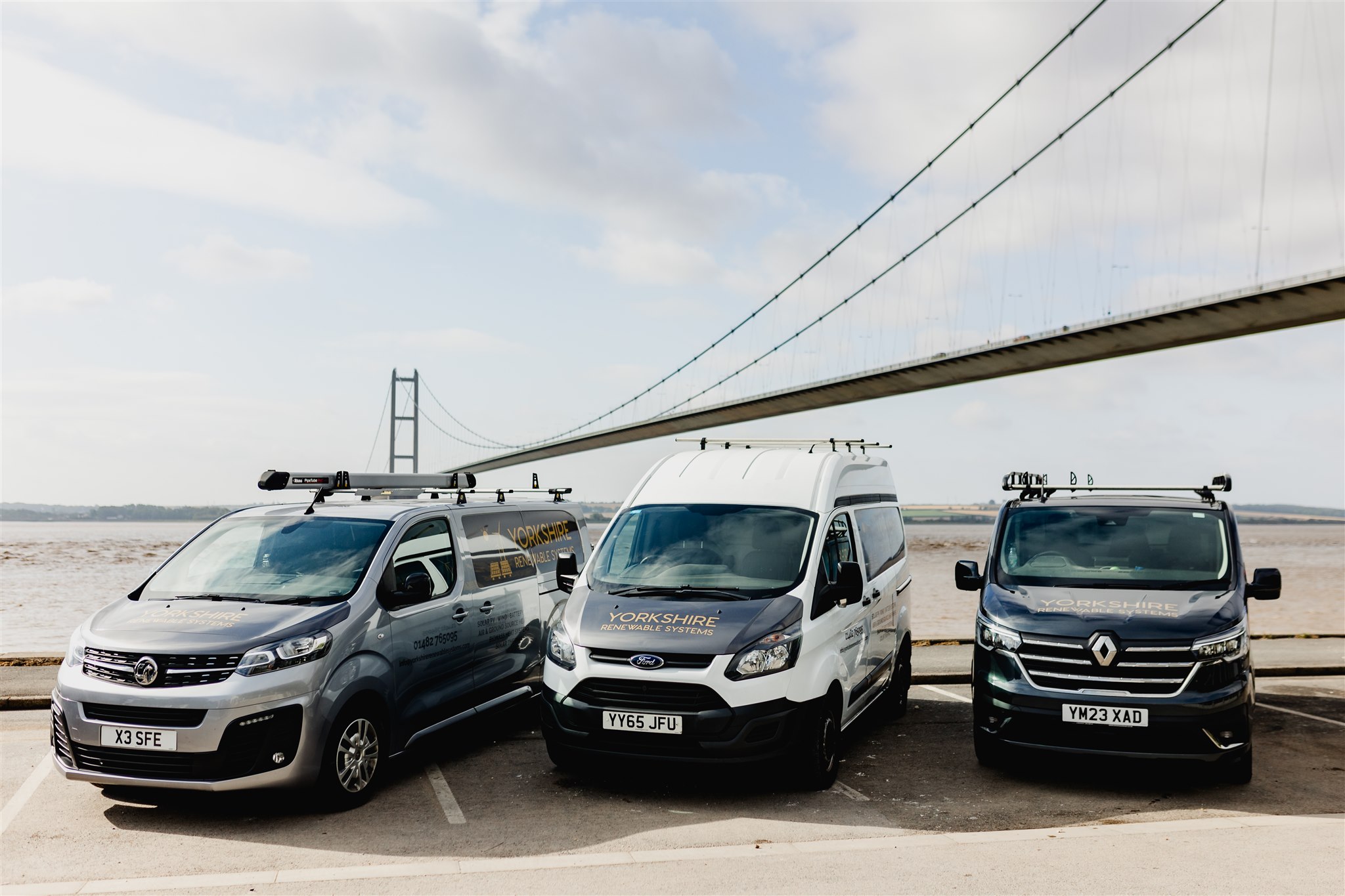
Roof and Building Checks Before Your Business Installs
A commercial array adds weight to a roof, fixings through its covering and new cable routes through the building. Before anyone prices panels, four questions about the building itself need answering. Each one is cheaper to settle at survey stage than after equipment has been ordered.
1. Can the roof carry the load?
The Planning Portal says building regulations will normally apply when solar panels go on a non-domestic roof. The existing roof's ability to carry the weight of the panels has to be checked and proven, and some strengthening work may be needed. Building regulations also cover the fire protection and weatherproofing parts of the job. On our commercial projects, independent structural engineers verify the roof's load-bearing capacity before any panels are laid, as set out in the installation process above. If you have the building's original drawings or structural calculations, have them ready for the survey.
Planning is a separate question from building regulations. Our guide to commercial solar planning permission in England covers planning consent for rooftop solar on business buildings.
2. Is the roof fibre cement (asbestos cement)?
If your roof is corrugated fibre cement sheeting, treat it as asbestos-containing until a survey says otherwise. The Health and Safety Executive (HSE) lists fibre cement roof sheets, commonly called asbestos cement, among roofing materials that will not safely support a person's weight and can shatter without warning. Corroded metal sheets and many roof-light sheets are on the same list. HSE's asbestos essentials sheet a14, on removing asbestos cement sheets, says asbestos cement roofs are always fragile and cannot bear weight. Where sheets are overlaid with another material instead of being removed, it says to attach that material to the existing purlins and avoid drilling through the asbestos cement. HSE also reports that in agriculture roughly half the deaths and serious injuries caused by falls involve work on fragile roofs.
That has two practical consequences. First, in non-domestic premises someone has the duty to manage asbestos. According to HSE, that could be the building owner, the landlord, or the person or organisation responsible for maintenance and repair. Where no agreement says who, it falls to whoever controls the premises. HSE's steps for the dutyholder include making a register of asbestos and giving information to anyone who might disturb it, so ask for the asbestos register before the survey rather than after it. Second, a fragile roof changes how the work can be done safely, and on some buildings the roof covering may need attention before solar makes sense. If you run a farm, our agricultural solar page also covers ground-mount options for marginal land.
3. Has your building insurer agreed?
Tell your insurer before you sign an order. RC62, Recommendations for fire safety with PV panel installations, is a joint code of practice from RISCAuthority, MCS and Solar Energy UK. The 2023 edition focuses on fire safety for commercial and industrial rooftop PV and is written as a practical guide for insurers and their clients, covering procurement, ownership, operation and maintenance. Ask your insurer whether they expect the system to follow RC62, and get any conditions in writing so the design can meet them.
4. Do you lease the unit?
If you rent the building, start with the lease. Installing panels on leased premises typically needs the building owner's explicit permission. That permission is often given in a licence to alter, and a licence to alter often requires the tenant to restore the property at the end of the lease. Property solicitors point out that in many leases the roof is part of the premises let to the tenant, who has to keep it in good repair, and that adding panels may mean updating insurance policies. Before the survey, agree in writing who owns the system, who insures and maintains it, and what happens to it when the lease ends. Take legal advice on your own lease, because this section cannot replace it.
Exporting Surplus Power From a Business Site
Can a business get a Smart Export Guarantee tariff?
Yes, within limits. Ofgem's Smart Export Guarantee (SEG) covers solar PV installations with a total installed capacity of up to 5MW. Any export tariff for an installation above 5MW is a commercial contract outside the SEG. Electricity suppliers with at least 150,000 domestic customers must offer at least one SEG-compliant tariff to an eligible generator, and other suppliers can take part voluntarily. You apply to the SEG supplier of your choice, which does not have to be the company that supplies your electricity. Tariffs differ between suppliers and can change, so Ofgem advises shopping around and reviewing your tariff regularly.
To qualify, an installation needs suitable certification, an export meter that can take half-hourly readings, and an export MPAN. For solar PV up to 50kW, certification is typically an MCS certificate or an equivalent accredited scheme. Above 50kW, each SEG supplier decides how it satisfies itself that the installation is suitably certified, so ask your chosen supplier what it needs before commissioning.
Export income should not be what makes the business case work. Every kilowatt-hour you export is one you are not using on site, so if a proposal only pays back on its export assumptions, question the system size.
What export limitation means under G99
The Energy Networks Association's Distributed Generation Connection Guide (March 2026) says generation above 16A per phase connects under EREC G99 rather than G98. That threshold is 3.68kW on a single-phase supply and 11.04kW on a three-phase supply, so every system in the size table above needs a G99 application to the network operator. Northern Powergrid is the network operator serving the North East, Yorkshire and northern Lincolnshire.
Sometimes the local network cannot accept everything a site could export without reinforcement work. Northern Powergrid's code of practice for customer export limitation schemes (IMP/001/015, based on ENA Engineering Recommendation G100) sets out the alternative. A scheme on your side of the supply point measures power flows. It then restricts generation output, increases on-site demand, or both, so that net export from the site never exceeds its Agreed Export Capacity. Northern Powergrid must be satisfied that the scheme limits export in all circumstances. According to the code, export limitation can remove the need to contribute to reinforcement, or to wait for it before connecting, and it lets the generation be sized larger than the export cap. It does not solve every constraint: the code says restrictions caused by fault levels are not managed this way.
An export limit does not stop you generating. It does mean that any generation above what the building uses plus the agreed export figure has to be absorbed by extra on-site demand or is not generated at all. On a site with a steady daytime load that may cost very little. On a building that sits largely idle on sunny weekends, the lost generation can be significant. Where an export limit is likely, ask for the curtailment to be modelled in the proposal. If you run a large logistics building, our warehousing and logistics solar page covers the technical considerations for those roofs.
Frequently asked questions
Can solar panels be fitted to an asbestos cement roof?
What is an export limit on a commercial solar system?
Do I need my landlord's consent to install solar panels on a leased unit?
Updated September 2026.
Start Your Project Today
Ready to reduce operational costs or improve your home's rating? Fill out the form for a free, no-obligation survey. We operate throughout Yorkshire.
Email Us
Visit HQ
Office 4, Blanket Row, Hull, HU1 1TB
Serving the Hull & East Yorkshire area
Commercial solar across our 30-mile radius
Commercial Solar System Sizes & Costs in Yorkshire
Most commercial solar panel installation Yorkshire enquiries we price fall into five size bands. Yorkshire roofs typically yield 850–900 kWh per kWp installed per year, so payback maths here is stronger than many operators expect — especially for businesses on daytime-heavy load profiles paying 24–28p/kWh.
| System size | Indicative installed cost | Annual generation (Yorkshire) | Typical payback |
|---|---|---|---|
| 20 kW | £16,000–£21,000 | ~17,000–18,000 kWh | 5–7 years |
| 50 kW | £36,000–£46,000 | ~42,500–45,000 kWh | 4–6 years |
| 100 kW | £66,000–£82,000 | ~85,000–90,000 kWh | 4–6 years |
| 250 kW | £155,000–£195,000 | ~212,000–225,000 kWh | 4–5 years |
| 500 kW | £290,000–£360,000 | ~425,000–450,000 kWh | 4–5 years |
All figures indicative — verified July 2026. Final pricing depends on roof type, access, cabling runs and export arrangements.
Tax Treatment: Get the Capital Allowances Right
Solar panels are classed as special-rate plant for capital allowances — they do not qualify for full expensing, which applies to main-rate assets only. Two routes matter:
- Annual Investment Allowance (AIA): 100% deduction in year one on up to £1m of qualifying spend — covers every system in the table above for most Yorkshire SMEs. This is usually the best route.
- 50% First-Year Allowance: for companies that have exhausted their AIA, half the cost is deducted in year one, with the balance written down at 6% in the special-rate pool.
A 100 kW system at ~£74,000 claimed through AIA saves a 25% corporation-tax payer roughly £18,500 in year one — confirm your position with your accountant before ordering.
Which Buildings Suit Commercial Solar Best?
| Building type | Typical fit | Why it works |
|---|---|---|
| Warehouse / distribution | 100–500 kW | Large flat or low-pitch steel roofs; daytime refrigeration and handling loads |
| Factory / manufacturing | 50–250 kW | High constant baseload means 70–90% self-consumption |
| Farm buildings | 20–100 kW | South-facing barn roofs; cooling, drying and dairy loads |
| Offices | 20–50 kW | 9–5 usage matches generation curve almost exactly |
You can see how we approach each building type on our sectors we serve page.
Grid Connection: The G99 Process
Any system above 3.68 kW per phase needs Distribution Network Operator approval under G99 before energisation. In Yorkshire that means an application to Northern Powergrid. We handle the whole process: the application typically takes 4–12 weeks depending on local network capacity, and larger systems (usually 200 kW+) may receive an export limit or a connection-works quote. We apply early — before ordering hardware — so G99 never stalls your project. An MCS-certified installation and smart export metering also keep your Smart Export Guarantee options open for surplus generation.
Local Delivery Across Yorkshire
YEERS is a Hull-based MCS-certified installer covering the full region, with a 10-year workmanship warranty on every commercial install. If your premises are on the doorstep, our commercial solar Hull page covers local case detail; for the wider region, see commercial solar Yorkshire. Start with a free desktop assessment via our quote form — we’ll model your half-hourly consumption against roof yield and give you a real payback figure, not a brochure one.
Frequently asked questions
How much does commercial solar cost per kW in Yorkshire?
Indicatively £700–£1,050 per kW installed as of July 2026, falling with scale: a 20 kW system runs £16,000–£21,000 (~£800–£1,050/kW) while a 500 kW system runs £290,000–£360,000 (~£580–£720/kW). Roof type, access and cabling distance move the price, so a site-specific quote is essential.
Does commercial solar qualify for full expensing?
No. Solar panels are special-rate plant, which is excluded from full expensing (main-rate assets only). Instead, most businesses claim the Annual Investment Allowance for a 100% year-one deduction on up to £1m of spend, or the 50% First-Year Allowance if AIA is already used up.
What is the payback period for commercial solar in Yorkshire?
Typically 4–7 years depending on system size and self-consumption. Yorkshire roofs generate roughly 850–900 kWh per kWp annually, and businesses with strong daytime loads paying 24–28p/kWh see the fastest returns — larger systems (250–500 kW) often pay back in 4–5 years.
Do I need permission from the grid operator to install commercial solar?
Yes. Any system above 3.68 kW per phase needs G99 approval from your Distribution Network Operator — Northern Powergrid across most of Yorkshire. Applications typically take 4–12 weeks, and larger systems may receive an export limit. We submit the G99 application on your behalf before ordering equipment.
Can my business sell surplus solar power back to the grid?
Yes, through the Smart Export Guarantee or a commercial power purchase arrangement. Indicative SEG rates range from around 1p to 27p/kWh depending on supplier and tariff, and you'll need an MCS-certified installation plus a smart export meter. That said, most commercial systems are sized so 70–90% of generation is used on site, where it's worth far more.
Which commercial buildings are best suited to solar panels?
Warehouses and factories are the strongest fit — large steel roofs and constant daytime loads support 100–500 kW systems with high self-consumption. Farm buildings suit 20–100 kW on south-facing barn roofs, and offices suit 20–50 kW because 9–5 occupancy matches the generation curve closely.
Last updated July 2026.
